VAKHTANG (VATI) DAVITASHVILI
The Window
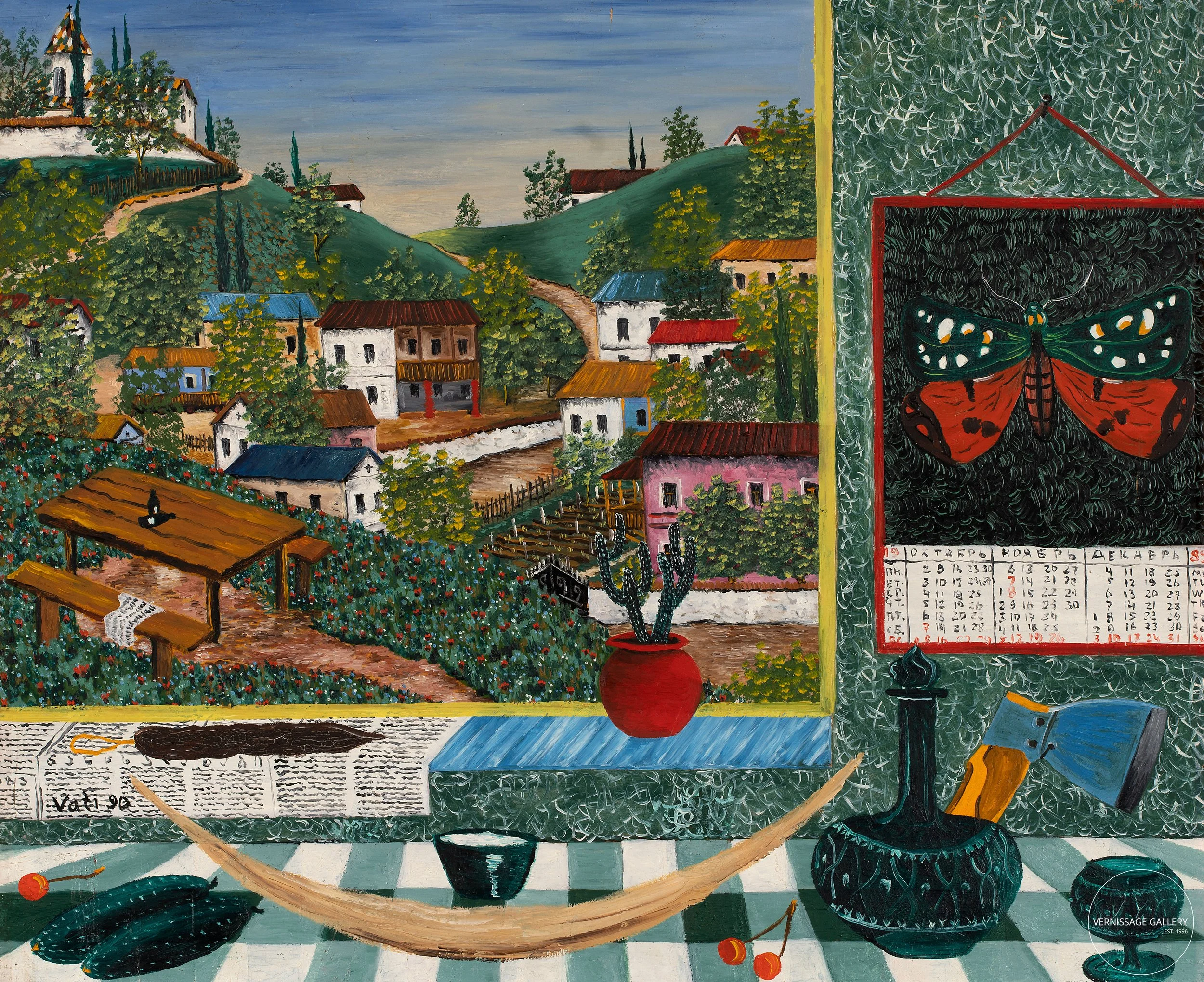
Vakhtang (Vati) Davitashvili PURMARILI. Photo Courtesy of Vernissage Gallery. Photographer: Gia Chkhatarashvili.
Social realism, officially endorsed since the 1930s, set the course for Soviet art, thereby ending the illusion of bringing about revolutionary changes in the field. However, the decades-old artistic tradition in sovietised countries was not entirely erased. It survived outside of exhibition spaces, in studios and museums. Years later, this legacy and the artists who had survived soviet repressions, along with other factors, prepared the ground for the development of unofficial, so-called nonconformist art. Evolving into an art as well as social movement with a fully conceptualized agenda well beyond painting proper, nonconformism was represented by free artists who built their private, autonomous artistic and existential dimension to resist Soviet reality. They challenged Soviet community not only by their art, but also by their lifestyle, consistently opposing the utilitarian approach to art and its servitude to ideology.
From the 1960s, free from the limitations of the Academy, professional school and ideological control, Georgian non-conformist art, as expected, mostly developed among amateur artists. Literature as well as fine arts remained discrete, ‘self-contained’, until the process broke through the boundaries to assert itself as an exciting, important event in Georgian culture. Some of the Georgian underground artists were inspired by Western art, which would penetrate, although weakly, the Iron Curtain through various magazines and publications. For others, the source of inspiration was local artistic tradition and folk art, including Pirosmani’s works. It is the latter that the visual language and poetics of Vakhtang (Vati) Davitashvili are based on and suggest an original interpretation of.
Vati Davitashvili was introduced to the world of art by Sergo Parajanov and, naturally, was influenced by the great master and the underground artists gathered around him. At that time, Davitashvili was enrolled at the Kiev School of Aviation. After returning to Georgia, he worked in Avto Varazi’s studio.
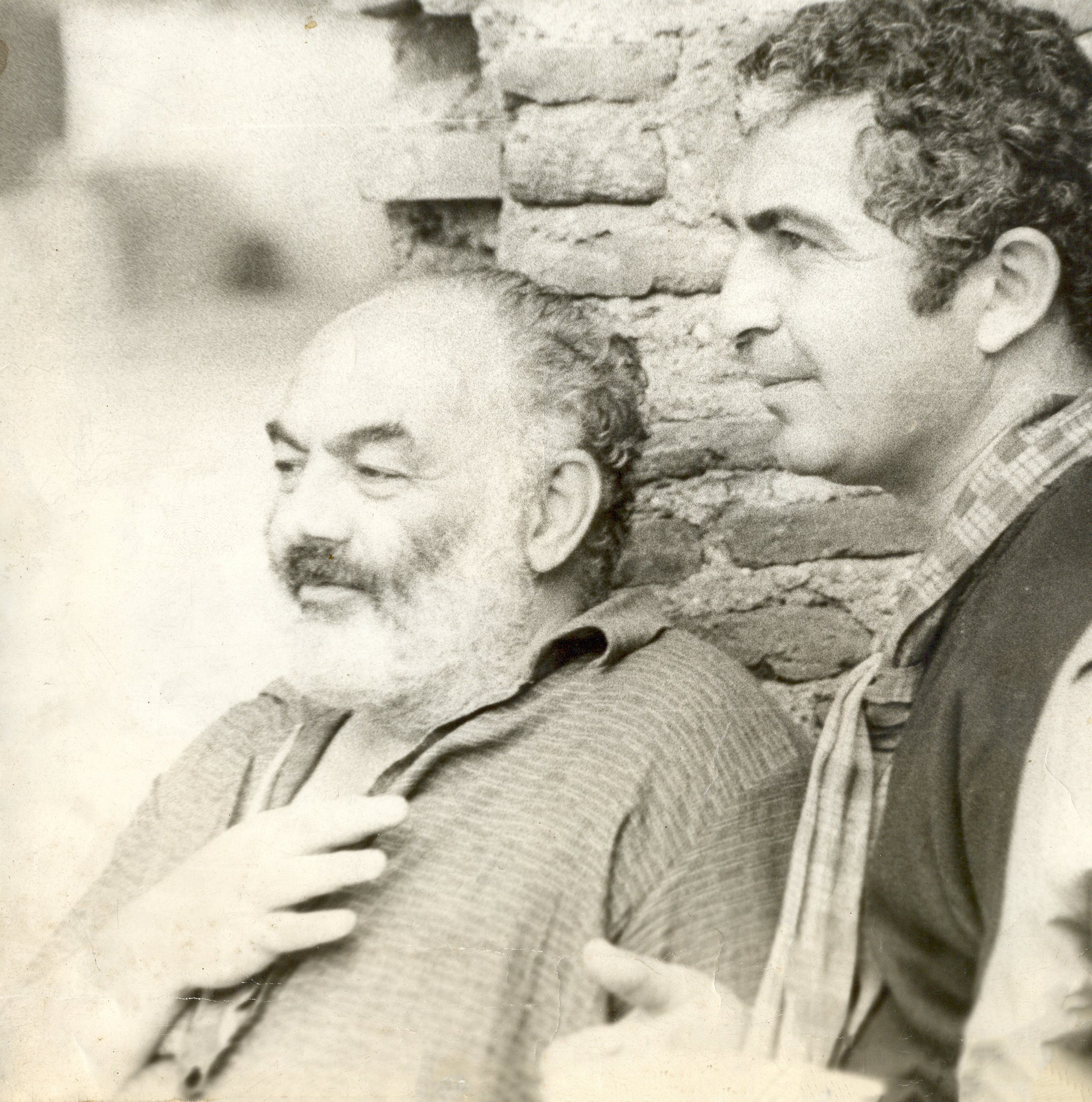
Vakhtang (Vati) Davitashvili (right) with Sergo Parajanov. Photo Courtesy of Vernissage Gallery.
Davitashvili’s works lack experimentation with plasticity and materials, as well as new conceptions, all of which were typical of nonconformism. Neither do they offer conceptualisation and grotesque representation of the social aspect of the Soviet regime. In contrast to the intensely heroic mood dominating Soviet art, they visualize the poetics of nature, daily life and feast in Kakheti, the artist’s native province. Davitashvili’s aesthetic worldview and visual language are closer to naïve art by their immediacy and purity. Moreover, they deeply contrast the falsity and hollowness of Soviet reality.
Davitashvili’s studio in Telavi is an archive of nonconformist art. It preserves photos, posters and inscriptions that tell the long story of the movement in a compelling way, placing the viewer in the center of those events.
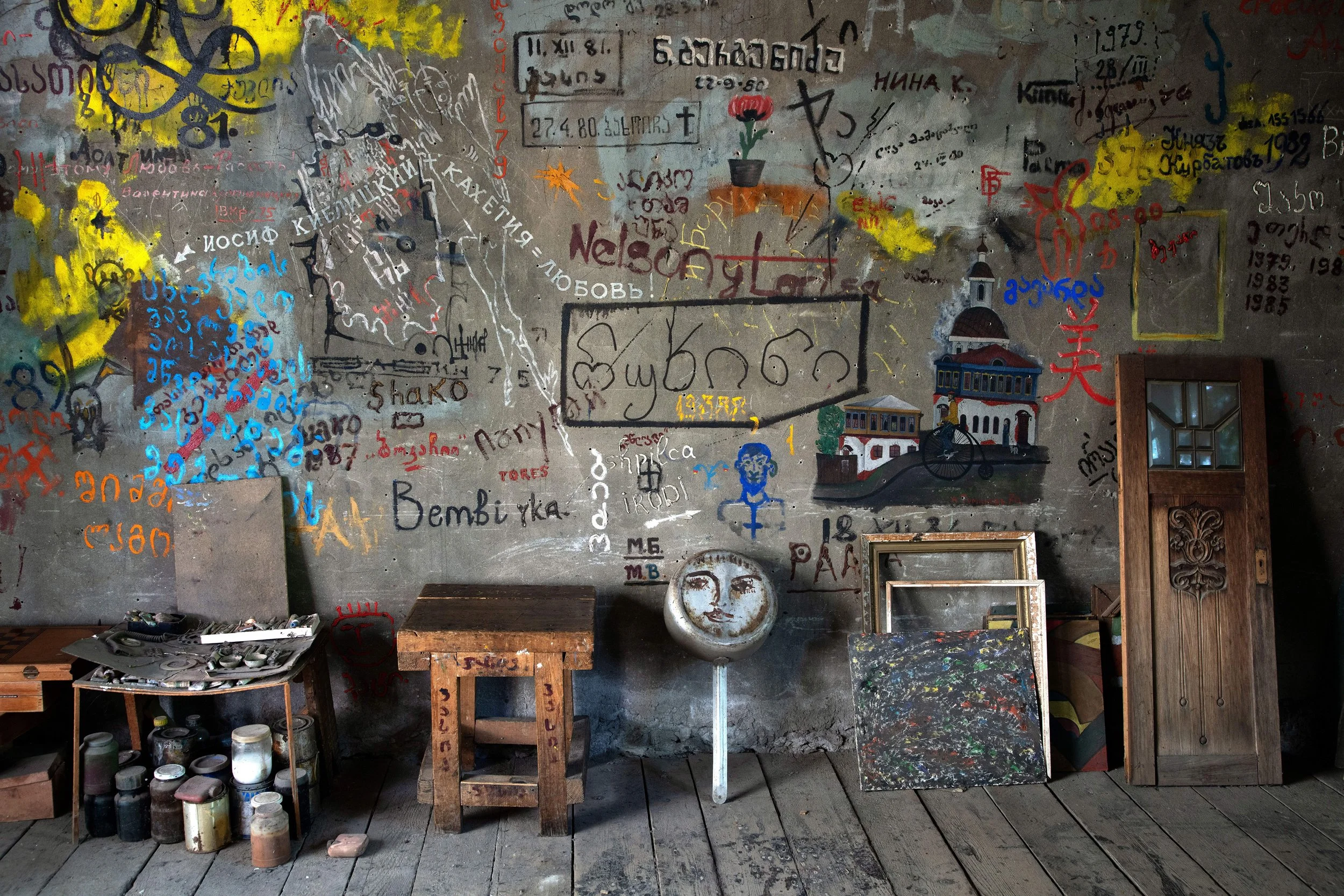
Vati Davitashvili’s Studio in Telavi. Photo Courtesy of Vernissage Gallery. Photographer: Gia Chkhatarashvili.
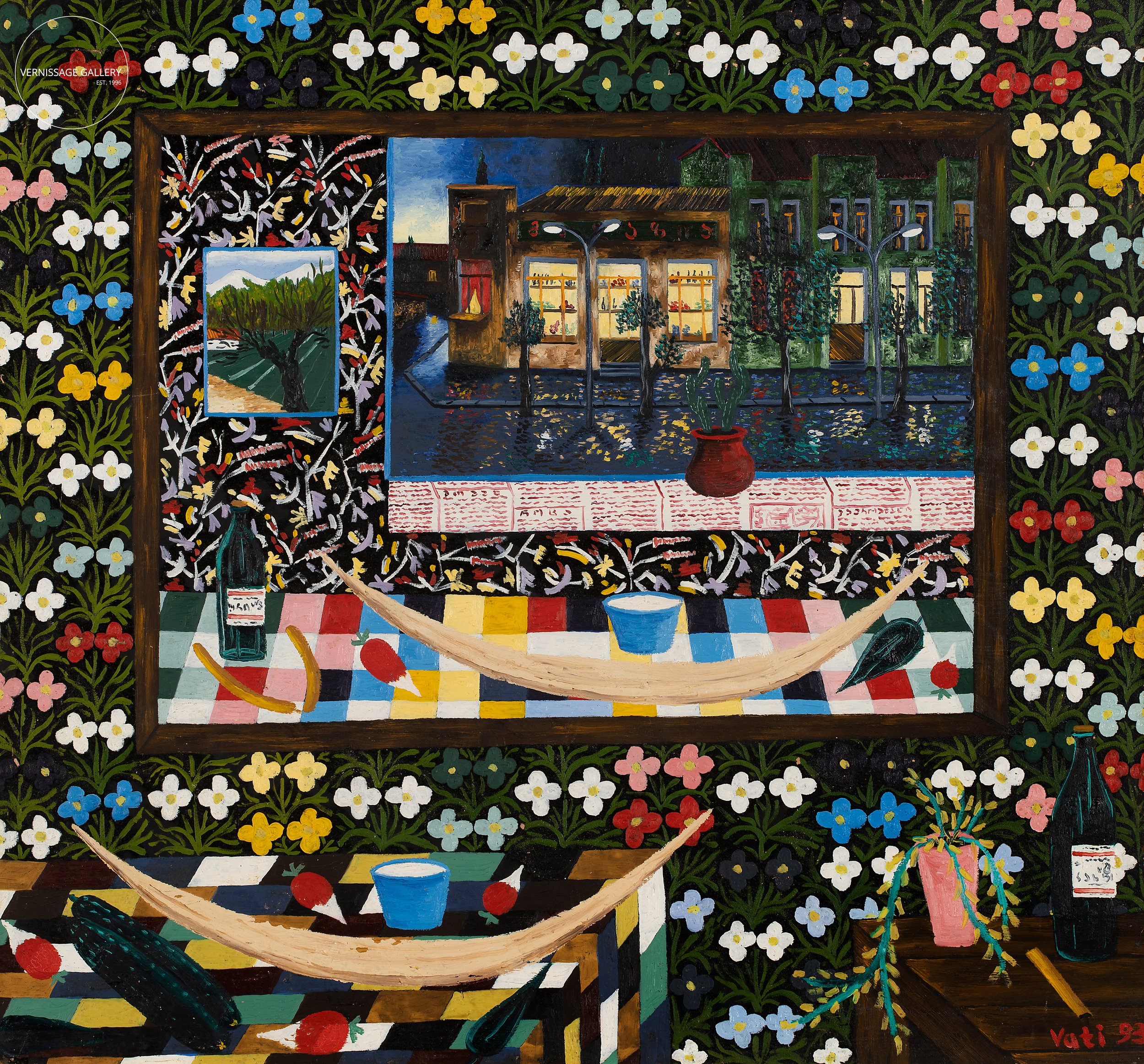
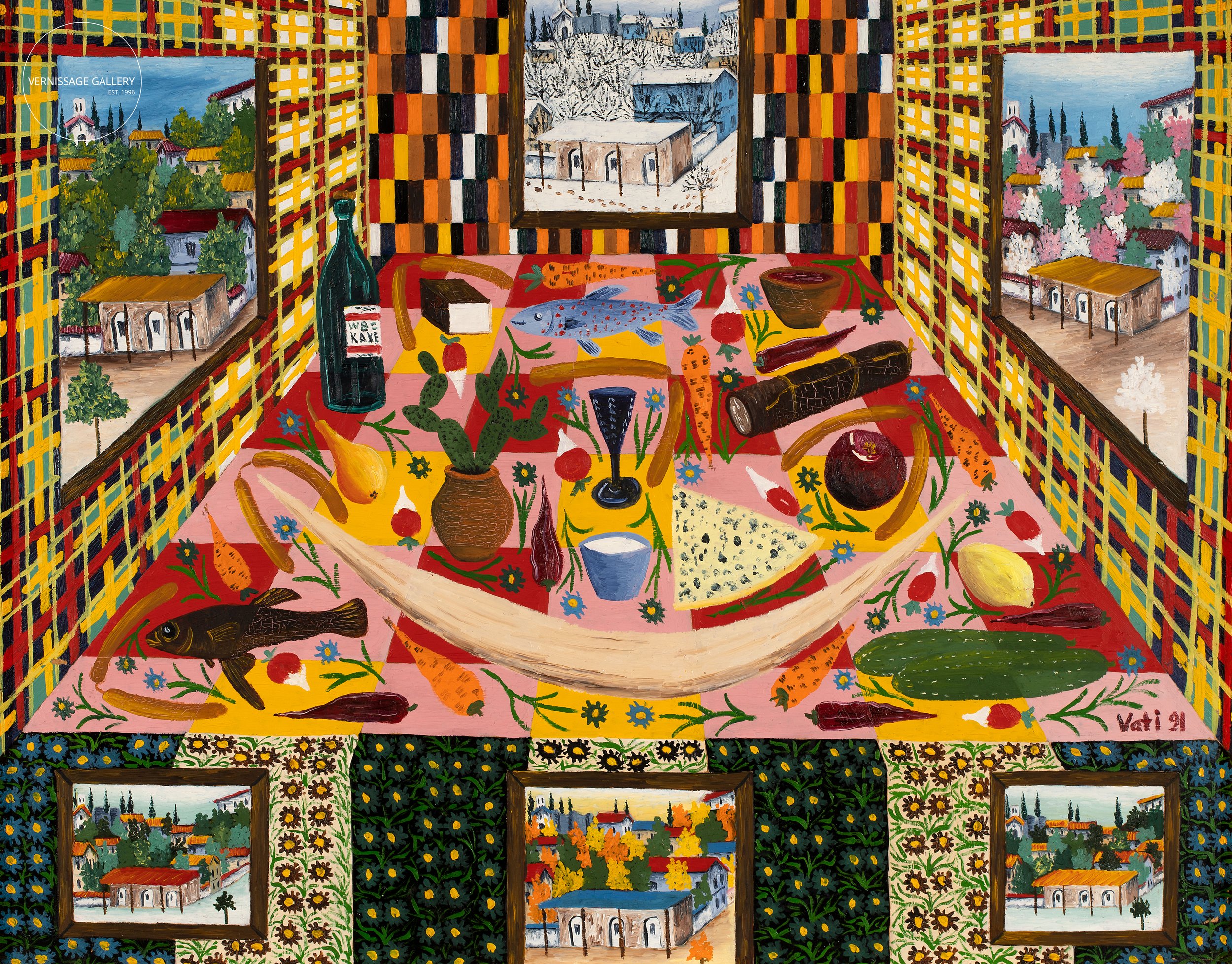
Davitashvili’s paintings predominantly depict generic scenes, their central theme mostly being a landscape or still life, often enframed in multiple rows of decorative patterns with alternating geometric and floral ornaments. Repetitive patterns add a decorative dimension to his works. The rendering of the local spirit, the use of ornamental motifs and balanced light, as well as the general mood of the paintings, carry the viewers to a world that stands out with its individualism. It is peaceful, leaving no room for aggression and violence.
Vakhtang (Vati) Davitashvili PURMARILI. Photo Courtesy of Vernissage Gallery. Photographer: Gia Chkhatarashvili.
Davitashvili’s painting hanging on the studio wall is in fact a window into the world from which the artist beholds it. The motifs in the painting repeat the still life laid on the table. Davitashvili is the beholder of the world and, at the same time, part of it. Almost invariably, Davitashvili depicts his immediate surroundings where he feels comfortable: a village in Kakheti, a village church and alleys. He depicts different seasons of the year from different perspectives. However, the motifs are the same. His world is beautiful and slightly wistful, reminiscent of the good times. A loaf of flat bread and wine in a clay jug appear as symbols on the colourful surface. The paintings seem to be giving viewers a reason to engage in deep thoughts and reflect over something that is very important. A laid table appearing in Davitashvili’s compositions, modest but extremely appealing, invites associations with the artist’s and his friends’ (Baadur Balarjishvili, Zura Sekhniashvili, Vakhtang Rurua and others) recurring feasts, where they would endlessly talk about Georgian culture, literature and the future of their homeland. Davitashvili used to work privately. Almost no one but his close associates were familiar with his original compositions that were so different from the mainstream of the 1960s.
Vati Davitashvili’s paintings, like nonconformist culture in general, was a window cut in the confined space of Sovietism to access the values of the free world. It was an alternative for those who did not seek a cliché, make-believe reality in art, but sought immediacy, experience and mastery – the unparalleled world of an artist.
NANA SHERVASHIDZE
Vakhtang (Vati) Davitashvili PURMARILI. Photo Courtesy of Vernissage Gallery. Photographer: Gia Chkhatarashvili.
