ZURAB SEKHNIASHVILI
Acting under the slogan of equality, fraternity and unity of peoples, in October 1917, the Soviet regime destroyed the previous system of values with unparalleled cruelty and zeal. The culture and arts had to back down and even be came an ideological weapon in the Soviet rulers’ hands. The culture was constricted by the Socialist Realism cliché. However, along with “the obedient majority” there always are disobedient social groups, the so-called dissidents. It is this cohort of “protesters,” acting within various socio-economic and political conditions that starts undermining the polity.
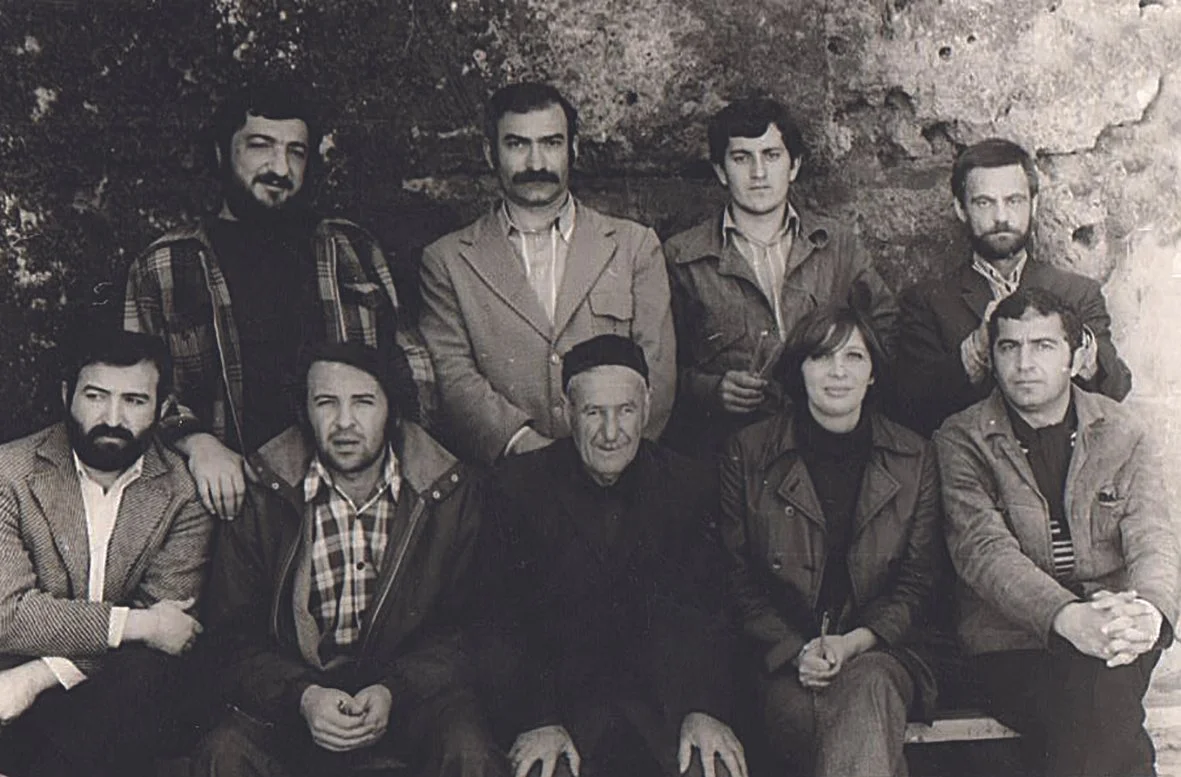
Zura Sekhniashvili (First raw, second from the right) with other Telavian artists and poets.
After the World War II, the first wave protest against the Communist ideology burgeoned in the arts. A kind of “aesthetic revolution” of the 1950s, gained ground in the major cities like Moscow and Leningrad to become a well-structured major, irreversible anti-regime force in the 1960s. In 1974, after the government crackdown on the exhibition of works by the so-called “informal,” dissident artists (“the bulldozer expo”) in Moscow, the group came into open and created an alternative artistic trend, which stood against the Soviet traditions and standards. Thus, the art was the first means by which the artists expressed their protest against the inhumane Soviet system. It was a totally different event which gave birth to modernism in the Soviet culture. To some extent, the concept of art so different from the official socialist realism revealed itself in nearly all the national cultures in the USSR and became a single system. What was similar to the artists of totally different creative thinking and tastes was their opposition to the Establishment and the art it supported. The opposition was evi dent across the culture. Despite of the stringent totalitari an rule and even aggression, the arts pushed through the political frames to express what the most open-minded people thought.
In Georgia, the artists like Messrs. Avto Varazi, Otar Ch khartishvili and Temo Japaridze led the nonconformist movement of the 1960s. Not only their worldview but their understanding of arts, creation and specifics of the material was completely different. After collages by Da vid Kakabadze, they were the first to experiment with the traditional oil and canvas, as well as common objects and utensils in order to create synthetic works of art. Those artists gave birth to a brand new aesthetics of visual arts. A bit later, Messrs. Zura Sekhniashvili, Amir Kakabadze and Vakhtag (Vati) Davitashvili joined the group. It is note worthy that but for a couple of exceptions (Otar Chkhartishvili, Amir Kakabadze) the synthetic artworks were created by non-professionals.
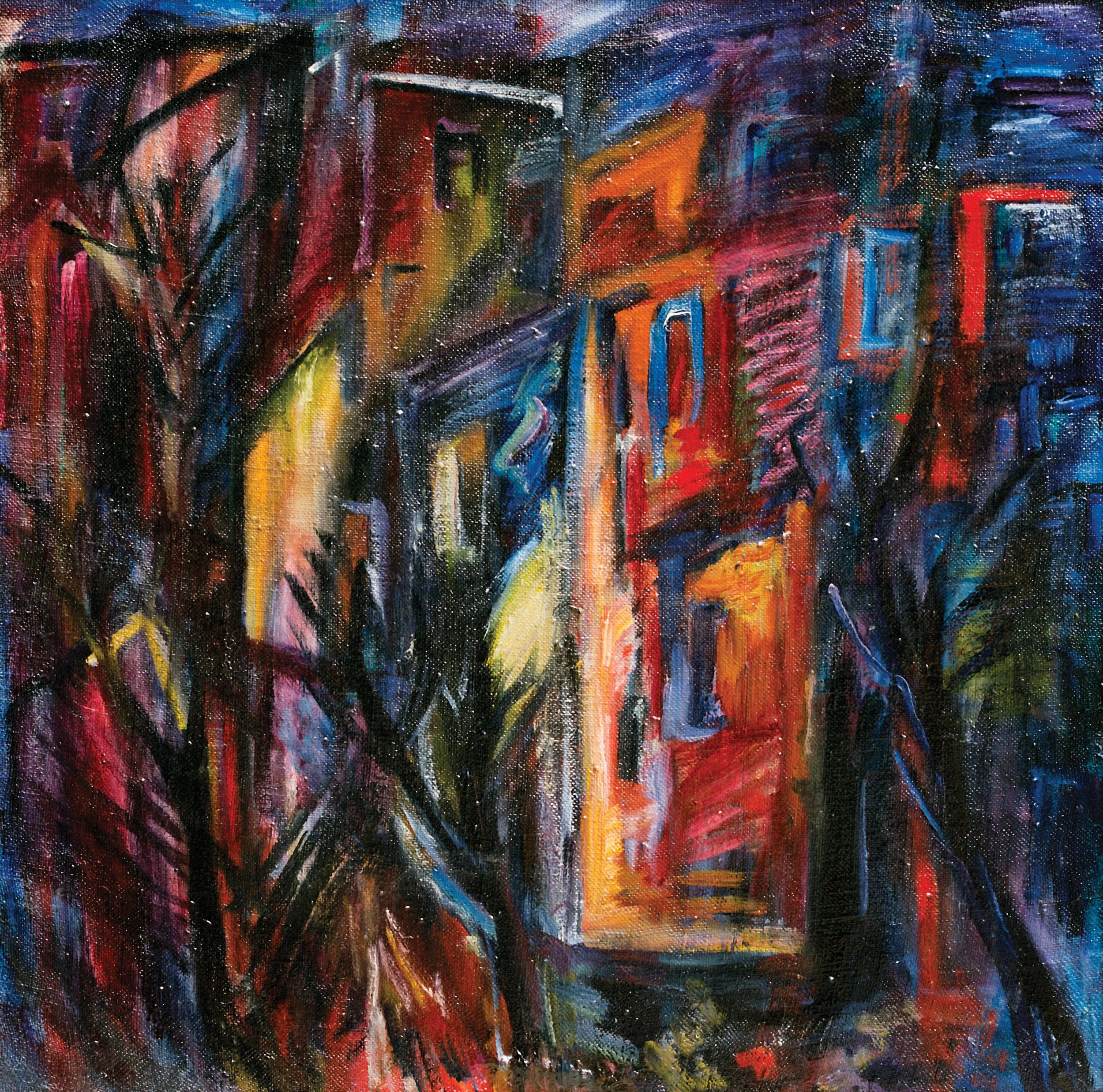
Zura Sekhniashvili THE CITY, oil on canvas.
Mr. Zura Sekhniashvili is an architect, more precisely so, the art restorer born to a typical Soviet family embracing the people of radically different views and backgrounds. On the one hand, there was Michael Pataridze, his grand father from his mother’s side, a former officer of the hussar regiment, the bodyguards of the Russian Emperor Nicholas II and a keen gymnast, mountaineer, translator and a poet, a like-minded friend of Niko Nikoladze’s. On the other hand, his uncle, father’s brother was a Soviet high official. “The dissidents” surviving the Communist repression were the role-models to their younger generation family members. Zura, who was very proud of his grandfather did not get on with the “chief” communists of his family. From the outset, he started painting abstractions. In his words, it should have been easier for him but maybe it was a way to express protest. What makes me think so are his later graphic sketches standing out for good understanding of his sitters and refined techniques.
In the 60s, the tightly closed door of the Western culture was set ajar and the Soviet literature and arts that had fallen from the Soviet rulers’ favor became relatively accessible. “Something exploded. It was a true cultural revolution!... It was an impregnated and an exciting period, like getting from darkness to light and seeing the sky, the grass, even the land, like a blind man seeing light for the first time. Such was the time”. The lifestyle as well as the art of the “informal” artists was contrary to the Soviet ideology.
Avto Varazi was surrounded by the Tbilisi artistic bohemia. He was a great influence on Zura. „I became friends with Avto. We both were painters and of course I wanted to learn something from him... One is in a constant quest, wishing to do something special, to find something his own. Otherwise, there is no sense… There are too many artists! Unless you find your niche, you will be a mediocrity, one of the ordinary artists. I’m not sure I’ve found something special but what I’m doing is my own. The artist was inspired by “Gitanes”, a composition by Varazi representing a crumpled box of cigarettes pasted to the cardboard, cigarette ends, match sticks and the other bits and bobs.
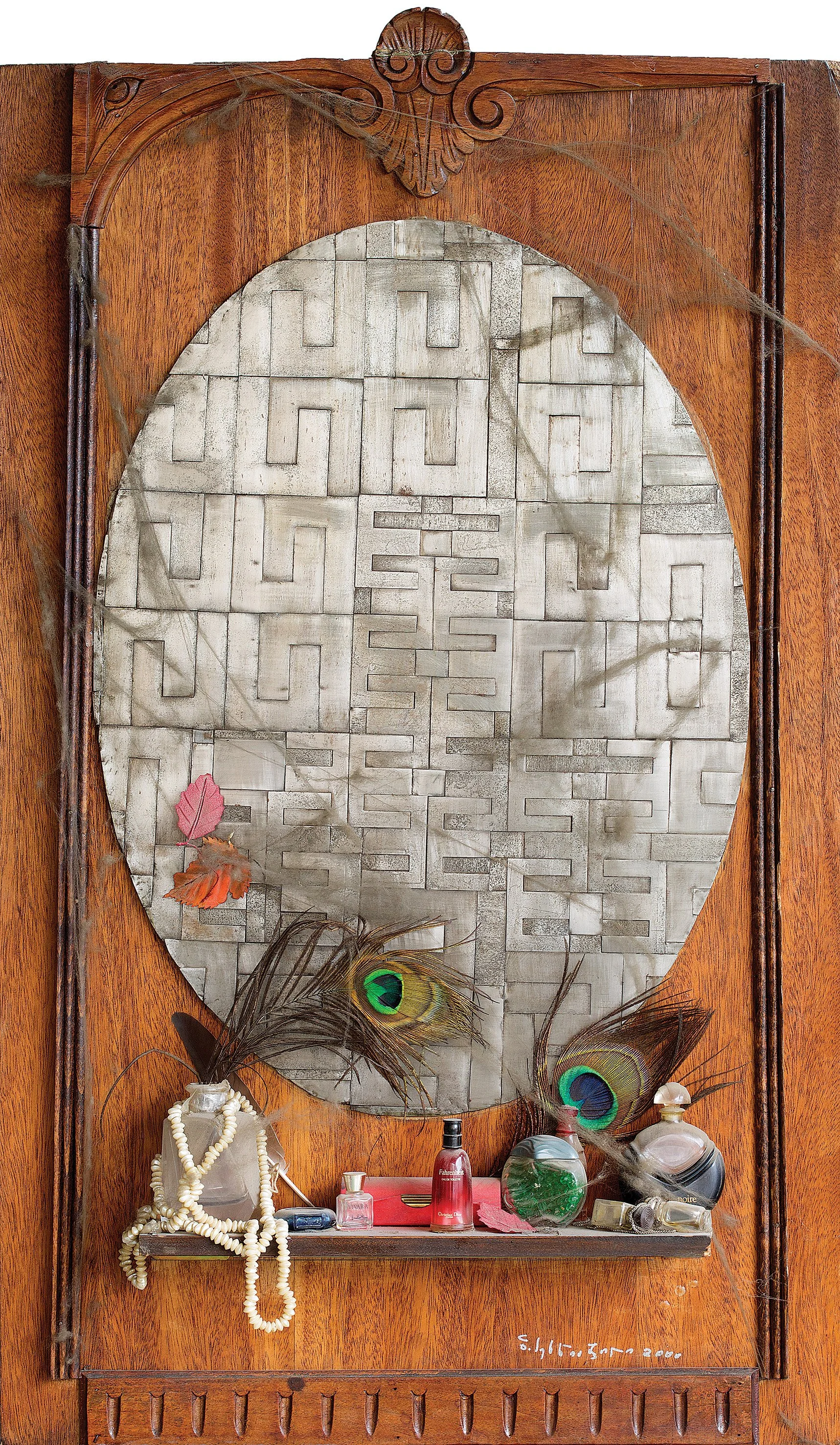
Zura Sekhniashvili COLLAGE.
As he says in one of the interviews, he got bored with painting landscapes, traditional oil paintings did not be come a means of self-expression for him. Although, he occasionally turned to the easel painting, but a collage, an object and the pop-art style still were his passion. His feelings and artistic taste that fell out with the “Soviet reality” are best translated in a kind of Objet d’Art (a collage of householditems). Zura was sharp-eyed for the things he needed. Sometimes a thing tossed away into the street gave him impetus and motivation for a composition, or a concept was realized by objects to be arranged on a plane or in space to form a composition. In his compositions, he rarely uses beautiful things and those are deliberately placed in the background. Commonplace, useless, ready to be thrown away or already thrown away things, wreck age, fans, pieces of tin, buttons gain a new lease of life in different combinations. However, the artist says he preferred “abstract, pointless works”, but these items carry some kind of content and they are the narrative of the time.
Intentionally or inadvertently a collage of objects be comes the icon of the time. A grating, a tape-recorder, an old phone membrane, a clock-dial, parts of various appliances arranged in a certain order brought together in a “pictured reality” are transformed into an artifact full of sub-texts and call up all sorts of associations stored in layers of our memory or consciousness: the cosmic space, the time past, the labyrinth... What seems to be a mishmash of color spots, shapes, textures and materials arranged on a plane forms artistic unity. Most of the com positions by Zura Sekhniashvili evoke a kind of mood-association. Rarely, the reference is very specific as it is the case with a 1986 work. Here the artist openly displays the event and his attitude to it. A piece of iron pasted to a surface with red spots on it is reminiscent of a locomotive, while a five-pointed star, the numbers “25” and “1921” painted in red refer to the occupation of Georgia by the Bolsheviks, a poignant issue for the artist.
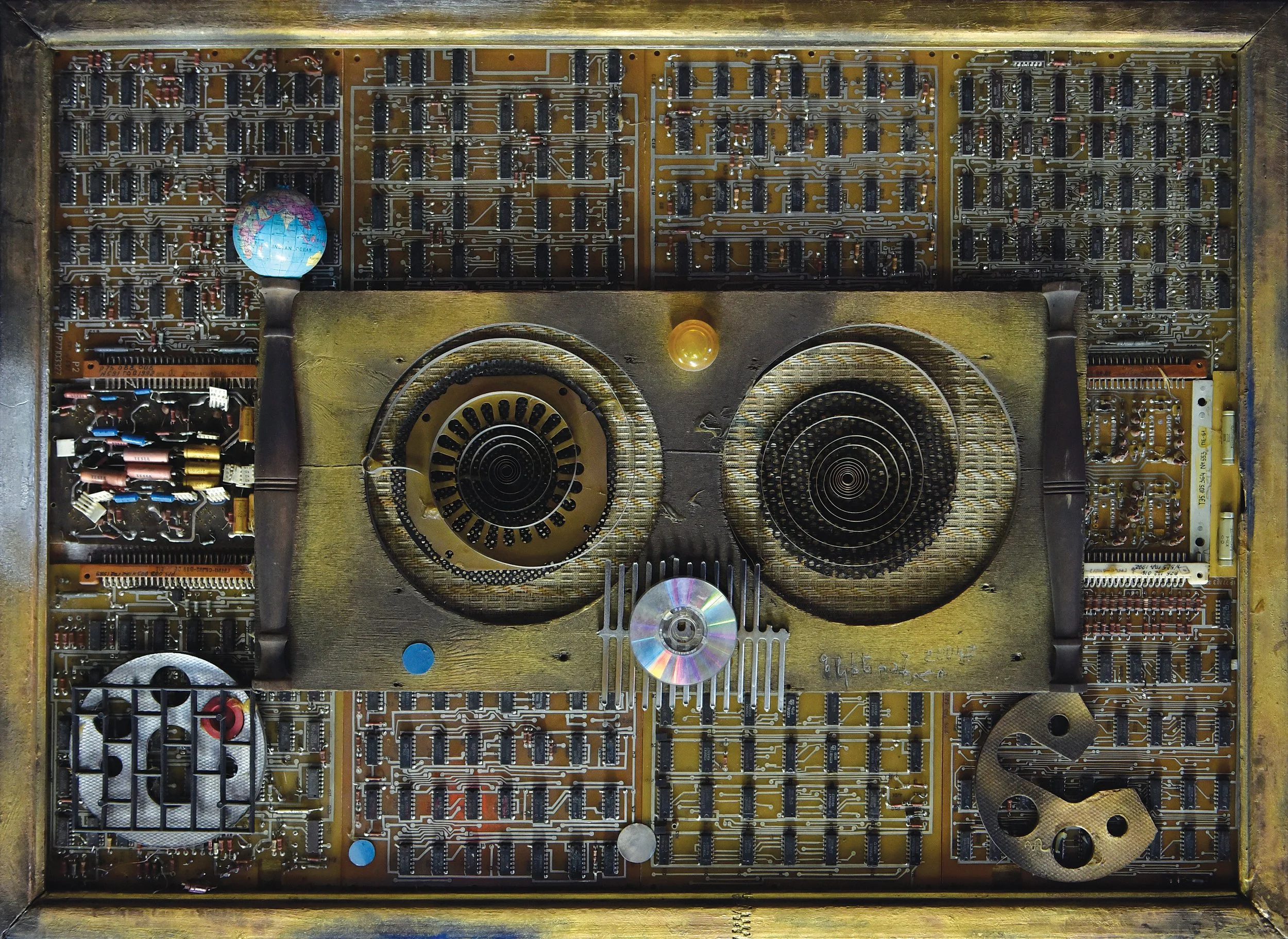
Zura Sekhniashvili RADIO LIBERTY.
Still, the art of Zura Sekhniashvili is considered to be more aesthetic than reformist or rebellious. His works are neither the soc-art – grotesque versions of the Soviet ideological art targeted against the ideological State nor the pop art – the art of ironic appeal with the consumer goods.
Zura is more of an onlooker trying to create a new model of beauty. Despite his large presence in art, he seems to be looking for peace and quiet. As he says,: “perhaps time has to pass... I don’t think that we are shunning some thing, perhaps the protective mechanism works _ it’s hard to talk about open wounds.
This “lyric” characteristic to the artist curiously manifests itself in his works made up of “secondhand things”.
NANA SHERVASHIDZE
