
HERMANN HESSE THE PAINTER
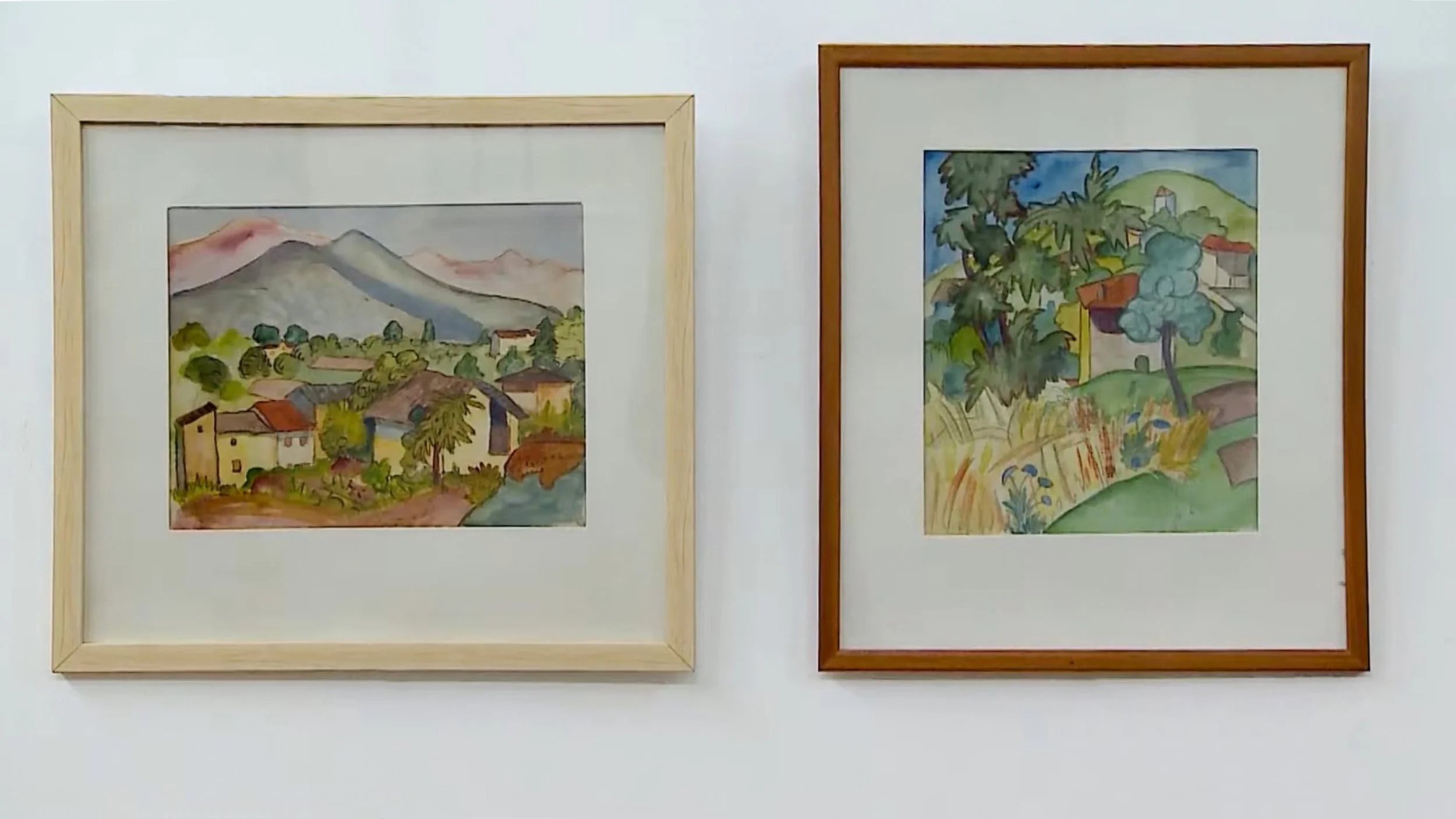
Installation view of two Hermann Hesse landscapes on view at Vernissage Gallery.
Image Courtesy: Vernissage Gallery.
"The process of creating with pen and brush is, for me, like a fine wine. The intoxication it brings warms and beautifies life to the point of making it bearable." - Hermann Hesse, from a letter to Franz Ginzkey, 1920
Hermann Hesse - German-born, later Swiss, prose writer, poet, and essayist; Nobel Laureate in Literature, 1946 - is far less well known to the general public as a painter. So when Gallery Vernissage invited us — not in Berlin or Bern, but here in our own capital - to the exhibition "Two Landscapes by Hermann Hesse," my first reaction was, I'm sorry to admit, more surprise than joy.
The exhibition is a group show in Vernissage's now-familiar format of a survey exhibition and sale. This time, however, alongside works by contemporary Georgian artists and photographers - regular collaborators of the gallery - we were also treated to older works, now part of art history: works by Russian artists Prince Grigory Gagarin and Vera Rokhlina, and by Georgian masters Elene Akhvlediani and Sergo Kobuladze, encompassing painting, graphic art, and lithography. A quiet dialogue between past and present took shape.
Most remarkably, from January 22 to February 2, Gallery Vernissage hosted two graphic works by Hermann Hesse from a Georgian private collection - their permanent address, one presumes, being a Tbilisi bank vault. Such is the unvarnished prose of life. But rather than dwell on that, perhaps we are better served by turning to Hesse's prose - and to his painting, right?
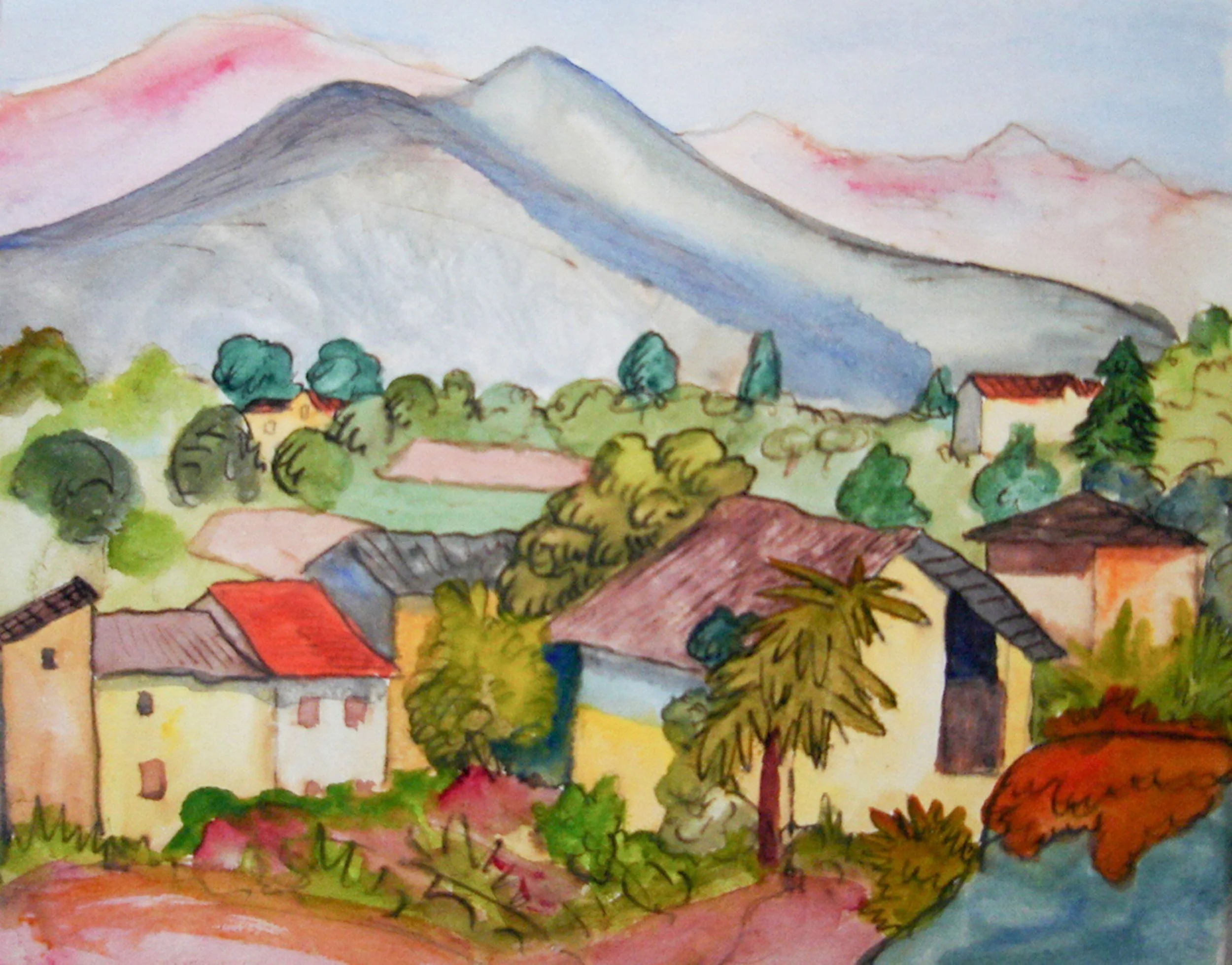
Hermann Hesse LANDSCAPE, Private Collection.
Image Courtesy: Vernissage Gallery.
To my surprise, at the opening on January 22 at 6 p.m., Gallery Vernissage - nestled in the heart of Old Tbilisi, at the far end of Kote Abkhazi Street - drew an unusually small crowd.
That this German writer, then in his early forties, first picked up pen and brush during the darkest years of the First World War is bound up with his profound depression, spiritual crisis, and a confluence of catastrophes both global and deeply personal. But how do we explain Georgian society's indifference to this exhibition - a lack of spiritual engagement, or simply a shortage of free time?
We can, of course, view Hesse's landscapes online, just as we can watch films and read books. But then, what use are galleries, cinemas, and libraries - or the fashionable media libraries at all? Should we simply do away with them? What is left, it seems, is to set against the self-absorbed "isolation" that has become our era's defining affliction - not Byron's splendid isolation, but its small, egotistical cousin - that old and weathered truth: man is a social animal. Let no one accuse me of calling for the collective to crush individual will. Call it love of one's neighbor, civic awareness, or solidarity - humanity is not the arithmetic sum of its individuals.
Hesse himself clearly believed as much. In 1914, in an article published in the Neue Zürcher Zeitung titled "O Freunde, nicht diese Töne" ("O friends, not these tones"), he implored German intellectuals to stop their grumbling and warned of the dangers of nationalist rhetoric - earning himself near-universal contempt in his homeland. Not long after, he left Germany and settled in Switzerland.
The following years brought him successive blows: the death of his father, his son's grave illness, and his wife's diagnosis of schizophrenia. These hardships made life almost unbearable for a man already prone to depression since youth. He was forced to give up his work supporting German prisoners of war and to seek treatment himself.
In 1916, the author of Knulp met Carl Gustav Jung, underwent psychoanalytic therapy, and - on his doctor's advice - began committing his dreams to paper, not in words but in drawings. Hesse is best known for his watercolors of the landscapes around Locarno and the Ticino. Given how essential walking was to his inner life, it is easy to see how this combination of the pleasurable and the restorative must have become a source of real peace - as his 1920 essay "Wandering" attests. And indeed, he not only overcame his crisis but returned to literature with redoubled force. Most of his masterpieces - Demian (1919), Siddhartha (1922), Steppenwolf (1927) - were written in the years that followed. "Without painting, I would not have achieved much as a poet," he wrote to Georg Reinhart in 1924.
Hesse never stopped painting. He organized several exhibitions, published an album of his work, and illustrated his own books. Yet he never considered himself a professional artist. "My little watercolors are a kind of poetic improvisation, or dreams - conveying only a distant memory of 'reality' and reshaping it according to personal feeling and mood (...). I am simply a dilettante, and I never forget it" (letter to Helene Welti, 1919).
It would, of course, have been possible to skip all of this - the personal history, the couch and the analyst's room. But without it, the origins of his watercolors would remain unclear, and more importantly, so would what they truly meant to their maker. "I found a way out of unbearable grief - I began to paint, something I had never done, and tried to make pictures. Whether they have objective value doesn't concern me; for me, this is the consolation of art, something that writing, in practice, never gave me. It is a passion without craving - like a love without pretension" (letter to Felix Braun, 1917).
Our thanks go to Gallery Vernissage and to Ms. Zaira Berelidze for this unexpected gift - which has given us yet another reason to revisit the great writer, thinker, and artist that was Hermann Hesse.
ALINA KADAGISHVILI
