
GRIGORY GAGARIN
NAIB OF SHAMIL: FROM SERIES CAUCASIAN COSTUME
10.05-22.06.2016
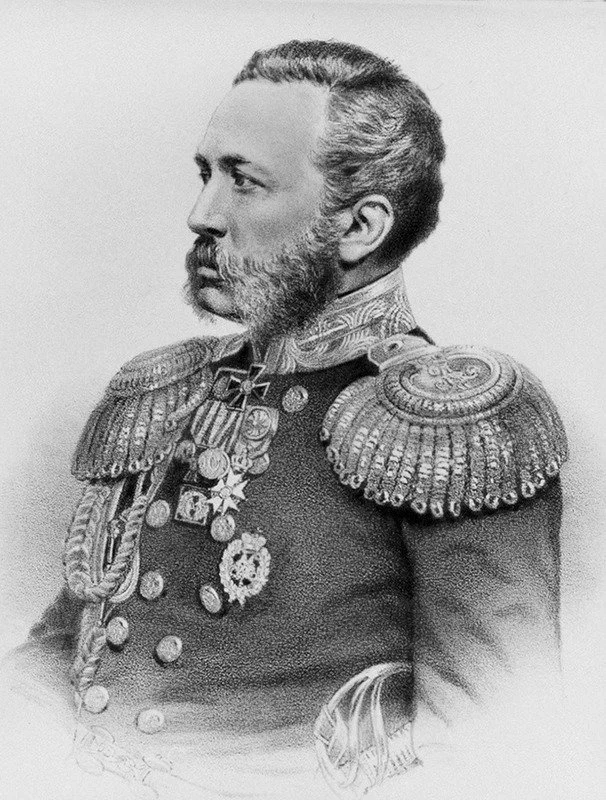
In 1839, following his return to Russia, Gagarin accompanied the writer Vladimir Sollogub to Kazan. The impressions gathered during this journey informed Sollogub’s literary work The Carriage, for which Gagarin later produced a series of illustrations (published in 1845). Executed with wit and a pronounced satirical sensibility, these drawings are considered among the notable achievements of 19th-century Russian book illustration.
A close associate of Mikhail Lermontov, Gagarin followed the poet to the Caucasus in 1840, where he participated in military campaigns and was decorated for his bravery. Alongside his military service, he produced an extensive body of visual work, including portraits, landscapes, battle scenes, and studies of historical monuments. These materials informed a number of later compositions dedicated to the Caucasus, such as Camp at the Second Crossing of the Alazani near Muganli, Group of Mountaineers, and The Battle between Russian Troops and Circassians at Akhtele, May 8, 1841.
From 1848 onward, Gagarin was based in Tiflis, travelling widely across Transcaucasia and documenting the region through his art. The scope of his activity during this period was remarkably diverse: in addition to his architectural and restoration projects, he worked in a Neo-Byzantine idiom in the decoration of Sioni Cathedral and oversaw artistic production at the Lapidary Works. His residence in Tiflis became an important cultural meeting point for the city’s intellectual and artistic circles.
From the mid-1850s, Gagarin resumed his work in St. Petersburg, where he contributed to the reform of the Imperial Academy of Arts and published significant albums, including Picturesque Caucasus and Costumes of the Caucasus. He continued to engage in ecclesiastical painting and research in art history. In 1859, he was appointed Vice-President of the Academy of Arts, a position he held until 1872, when he resigned amid mounting pressure from conservative bureaucratic forces.
Although Gagarin possessed considerable artistic talent and technical skill, his aristocratic background and parallel administrative career limited the extent of his artistic output. As a result, his contribution to the arts, while significant, remains more modest than his abilities might have otherwise allowed.
Vernissage Gallery is thrilled to present GRIGORY GAGARIN:NAIB OF SHAMIL.
Prince Grigory Grigorievich Gagarin (1811–1893) was a Russian painter, military officer, and administrator whose multifaceted career intersected significantly with the cultural life of Tiflis (present-day Tbilisi), where he was active between 1848 and 1855. During this period, he played an important role in shaping the city’s artistic and architectural landscape: he designed and constructed a theatre, executed frescoes for the Sioni Cathedral, and undertook the restoration of wall paintings in several Georgian Orthodox monuments, including the Betania Monastery.
Born into an aristocratic family and the son of a diplomat, Gagarin received an early artistic education that was further enriched during his formative years in Italy, where he lived from 1816 and came into contact with the circle of Karl Bryullov. Upon returning to St. Petersburg in 1832, he continued to pursue art alongside his official duties. Between 1834 and 1836, he travelled aboard the brig Themistocles from Athens to Constantinople as part of a diplomatic mission.